Scientific journal articles
Browse our collection of scientific journal articles on soilless substrates.
Publications Index
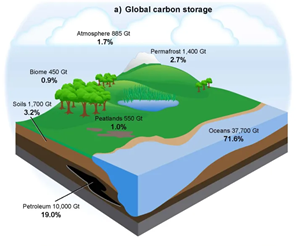
Altland J and Bugbee B 2026. The limits of sustainability of peat as a soilless media for agriculture.. Front. Plant Sci. 17:1856037. https://doi.org/10.3389/fpls.2026.1856037.
Soilless media has long been used to improve fertilizer and water use efficiency of high-value crops in containers, and global demand for these media is predicted to increase 250% to 400% in the next 25 years. The environmental impact of all soilless media products warrants detailed analysis. The unique properties of peat make it the most widely used product. Peatlands are vital carbon stores and the historical degradation of European bogs has prompted regulations restricting peat extraction. Unlike Europe, North American peatlands—particularly in Canada—are largely pristine and have the potential to be sustainably managed. A focus on restoration, coupled with more ∨
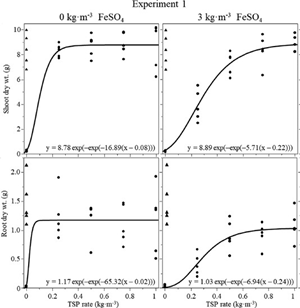
Altland, J., Shreckhise, J., & Pancerz, M. 2026. Ferrous sulfate reduces phosphate leaching in peat-based substrates. HortScience 61(6):1121-1130. https://doi.org/10.21273/HORTSCI19312-26.
Phosphate leaching from container-grown crops can have negative environmental impacts and has become one of the greatest production challenges since the advent of soilless substrates. The research aimed to evaluate the effect of ferrous sulfate (FeSO4) on phosphorus (P) leaching and marigold (Tagetes patula L.) growth in peat-based substrates to determine its suitability for short-cycle floriculture crops. Two greenhouse experiments were conducted in Wooster, OH, USA, using sphagnum peat:perlite substrates amended with 0 or 3 kg·m−³ FeSO4 and varying rates of triple superphosphate (TSP; 0–1 kg·m−³). Marigold cultivars Durango Orange and Durango Yellow were grown under controlled conditions, fertigated with more ∨
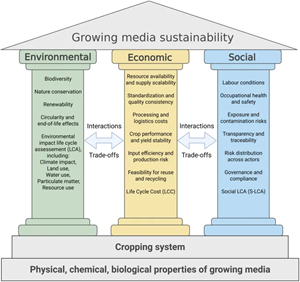
Aurdal SM, Sentinella AT, Schmilewski G, Altland J, Caron J, Alexander P, Holtkamp M, Vandecasteele B and Alsanius BW 2026. The challenge of defining “sustainable growing media”: why the term is used incorrectly and what needs to be done about it. Front. Hortic. 5:1800902. https://doi.org/10.3389/fhort.2026.1800902.
The term “sustainable growing media” is widely used in horticultural research, policy, and industry, yet its meaning remains ambiguous, inconsistently applied, and often unsupported by evidence, undermining the very decisions it is meant to guide. Materials are frequently characterised as sustainable based on single attributes, such as being peat-free, recycled, renewable or aligned with policy priorities, without demonstrating reliable horticultural performance, economic viability, social responsibility or reduced environmental impact within real production systems. This paper examines why defining sustainable growing media has proven persistently challenging and why a single, universal definition may be neither achievable nor even useful. Drawing on more ∨
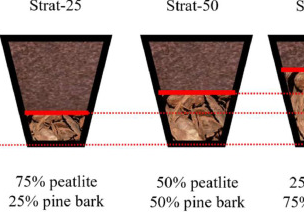
Jeb S. Fields, Kristopher S. Criscione, James S. Owen 2024. Conventional sphagnum peatlite substrate can be reduced by 50% in stratified substrate systems while growing equivalent size and quality
Pentas lanceolata. Scientia Horticulturae 331. https://doi.org/10.1016/j.scienta.2024.113121.
Floriculture crop production heavily relies on the use of peat-based substrates to quickly mass produce containerized crops. The sustainability of using peat moss has been an increasing concern for both horticultural stakeholders and the community. The concept of stratifying soilless substrates (i.e., vertically layering unique substrates atop of each other within the container) has been shown to reduce peat moss applications by upwards of 50 %. Although, most stratified substrate research has only studied an equal partition in which the substrate is evenly split into two layers. This necessitates further studying modification of the limits and optima for the depth more ∨
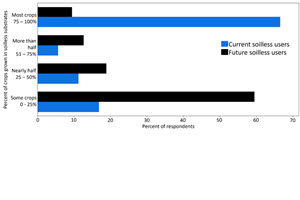
Fields, J. S., Owen, J. S., Jr., Lamm, A., Altland, J., Jackson, B., Oki, L., Samtani, J. B., Zheng, Y., & Criscione, K. S. 2023. Surveying North American specialty crop growers’ current use of soilless substrates and future research and education needs. Agriculture, 13(9), 1727.. https://doi.org/10.3390/agriculture13091727.
Many specialty crop growers are transitioning high-value crops from in-ground production to soilless culture due to the diminishing availability of fumigants, increasing pest pressure, extreme weather, and the need for flexible production practices. The objective of this study was to determine the research and educational needs of specialty crop growers who are transitioning to soilless substrates. North American growers were surveyed using an online instrument that incorporated Likert-type statement matrices, open-ended questions, and demographic questions. Additionally, two virtually led focus groups were conducted to further expand upon the quantitative findings with descriptive data. Respondents indicated the most important factors in more ∨
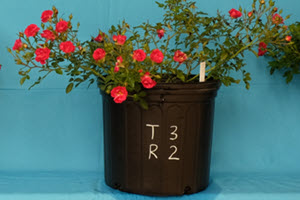
Fields, J. S., Owen, J. S., Jr., & Altland, J. E. 2021. Substrate stratification: layering unique substrates within a container increases resource efficiency without impacting growth of shrub rose. Agronomy, 11(8), 1454.. https://doi.org/10.3390/agronomy11081454.
Nurseries rely on soilless substrates to provide suitable growing media for container grown crops. These soilless substrates have been developed to readily drain water to prevent issues with waterlogging and associated soil-borne disease. A negative consequence of high porosity and subsequent drainage throughout the container profile is the required high or frequent irrigation rates with poor retention of applied nutrients. Substrates with relatively high levels of moisture and nutrient retention placed on top of a coarse and freely draining substrate could further optimize water and nutrient retention, while allowing for needed gas exchange for plant establishment and growth. Containerized Red more ∨